
















August 2026
Medical Misinformation
Table of Contents


The Doctors Company, the nation’s largest physician-owned medical malpractice insurer, announced that it has completed the acquisition of ProAssurance, a specialty insurer with broad expertise in medical liability, products liability for medical technology and life sciences companies, and workers’ compensation insurance.
Read more.
When Information Becomes Subject to Interpretation
People today interact with more content than our ancestors saw in a lifetime, but as we know all too well, not all information is created equal. Health and wellness is a key area where there are a lot of voices in the room, and it can be very difficult to find high-quality resources outside of a doctor’s office for top-of-mind questions.
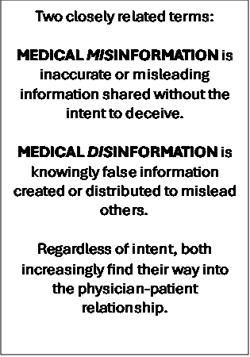
It is important to clarify the distinction between medical misinformation—false or misleading information shared without the intent to deceive—and medical disinformation—false information shared specifically with the intent to mislead. While both can be harmful to the physician-patient relationship, medical misinformation is far more prevalent than its more malicious counterpart.
Our issue focuses on examining medical misinformation and its impact on healthcare, litigation, and patient interactions—and the emerging challenges posted by artificial intelligence (AI) in medicine as content databases learn to interpret complex information. We have also gathered risk management recommendations on tactfully managing misinformation with patients in the clinical setting, as well as legal perspectives on combating questionable scientific information in courtrooms.
Our Risk Management and Claims staff are readily available to discuss pressing issues that may have your clients concerned. They are also available to assist with client meetings or interpret potential business opportunities in this rapidly changing healthcare landscape. Reach out to your Business Development representative anytime to set up a meeting at your convenience.
Medical Misinformation and Large Verdicts
How Mindset Affects Jury Deliberation
Medical misinformation now travels quickly through social media and other public channels, shaping how people interpret physicians, treatment decisions, scientific evidence, and risk. By the time jurors enter a courtroom, many have already absorbed ideas—accurate or not—that can influence how they hear testimony, evaluate experts, and discuss damages during deliberations.
That dynamic matters in medical malpractice litigation. Jurors are instructed to bring their common sense, life experience, and judgment into the deliberation room. Yet those same experiences may be colored by misinformation, persuasive storytelling, and claims that appear scientific but do not withstand rigorous scrutiny. The result can be a deliberative environment in which perception is difficult to correct and large verdicts become more likely.
"Tricks and treachery are the practice of fools, that don't have brains enough to be honest." - Benjamin Franklin1
The Courtroom Experience
The jury selection process, voir dire—French for “to speak the truth”—is intended to identify and exclude jurors with obvious bias. Once a jury is empaneled, however, each juror brings a lifetime of personal experience and assumptions into the courtroom. In an era of constant online information, those assumptions may include misconceptions about medicine, science, and the standard of care.
Plaintiff attorneys often present the first full narrative of the case because the plaintiff carries the burden of proof. That opening narrative can be powerful, particularly when it blends fact with emotion, or frames complex medical issues in a simple and memorable way. The defense must then respond not only to the evidence, but also to the perceptions created at the outset. This first-mover advantage can be significant, especially when jurors have already encountered medical misinformation that makes the plaintiff’s theory feel familiar or intuitive.
In recent years, manufactured science and medical misinformation have increasingly distorted public understanding of medical concepts. As Jennifer Freeden, ProAssurance Southwest Regional Risk Manager stated, “… we see a daily, rapid spread of medical misinformation that is truly uncharted and unregulated.”2 When those ideas make their way into litigation, they can mislead judges and juries and contribute to substantial monetary awards.
The challenge for defense teams is not merely to present contrary evidence, but to help jurors distinguish credible science from claims that only appear credible.
"Today's quote-unquote misinformation is tomorrow's standard of care." - Aaron Kheriaty, MD3
What Is ‘Junk Science,’ and Why Can It Drive Large Verdicts?
Opinions vary about the above-referenced Dr. Kheriaty, but his quote could become dangerously accurate if misinformation and junk science are accepted as fact. Jerry Theodorou of R Street defines “junk science” as “flawed expert witness testimony masquerading as sound science.”4 In practice, it may involve unreliable research, unsupported data, faulty analysis, or methods that lack the rigor necessary to establish validity. When presented by a witness with medical or scientific credentials, however, these opinions can appear authoritative to jurors.
That appearance of authority is precisely why junk science can be so damaging in a courtroom. If judges do not rigorously vet proposed expert testimony, jurors may hear opinions that sound scientific but rest on weak foundations. Once admitted, that testimony can reshape the case narrative, affect liability determinations, and influence the size of verdicts.
"A judge is not a scientist, and a courtroom is not a scientific laboratory. But the law must seek decisions that fall within the boundaries of scientifically sound knowledge." - Former Supreme Court Justice Stephen Breyer5
The Judge as Gatekeeper
The judge serves as the gatekeeper for the evidence a jury may consider. A central question is whether the probative value of evidence outweighs its potential prejudicial effect. Put differently, courts must decide whether evidence will help jurors reach a fact-based conclusion or instead encourage a decision driven by emotion, confusion, or bias. The same principle applies to scientific and medical evidence.
Courts have long recognized the need for standards governing scientific testimony. In Frye v. United States, 293 F. 1013 (D.C. Cir. 1923), the court addressed whether testimony about an early precursor to a polygraph test should be admitted. Because the method was not generally accepted as reliable, the testimony was excluded.
Decades later, Daubert v. Merrell Dow Pharmaceuticals, Inc., 509 U.S. 579 (1993), established a more robust framework for evaluating scientific expert testimony in federal courts. Under Daubert, courts consider whether the underlying premise has been tested, whether it has been subject to peer review, and whether the methodology is generally accepted within the relevant scientific community. These standards help connect expert testimony to reliable methods rather than unsupported personal opinions.
To strengthen testing for a reliable scientific basis upon which testimony could be given, the Federal Rules of Evidence bolstered Rule 702. Rule 702 states clearly that an expert witness must demonstrate to the court that their opinion is “more likely than not” based on scientific or technical expertise using facts, along with trustworthy testing methods, where the result reflects a reliable application of the resources used.6 In plain language, expert testimony cannot be pulled out of thin air, or be based on opinions without testing.
Although Daubert and Rule 702 are the prevailing federal standards, some states—including California and New York—continue to apply the Frye standard. The continuing variation among jurisdictions makes careful evidentiary practice especially important in medical malpractice cases.
"Fear and greed are potent motivators. When both of these forces push in the same direction, virtually no human being can resist." - Andrew Weil7
If Standards Exist, Why Does the Problem Persist?
The existence of evidentiary standards does not guarantee that unreliable expert testimony will be excluded. Many medical malpractice cases are filed in state courts, where judges may not be required to apply the federal Daubert, Frye, or Rule 702 framework. Even where gatekeeping standards exist, practical constraints can limit their effectiveness.
State courts are often under-resourced, and many judges manage increasingly crowded dockets. A hearing to evaluate the validity of expert testimony can require substantial time and attention. Some judges may conclude that weaknesses in an expert’s opinion should be handled through cross-examination rather than pretrial exclusion. That approach, however, can leave jurors to evaluate testimony that may never have met a meaningful scientific threshold.
The American Tort Reform Association’s The Junk Science Playbook8 describes a broader ecosystem in which plaintiffs’ lawyers, litigation-friendly laboratories, advocacy groups, and quasi-academic organizations generate studies that appear scientific but fall apart under scrutiny. Those studies may then be amplified through journals, media campaigns, and paid experts, creating the appearance of consensus where none exists. The Playbook also warns that a small cadre of highly compensated experts may offer opinions unsupported by established science, and that courts failing to apply evidentiary standards rigorously allow flawed theories to shape verdicts and settlements.
"Better is possible. It does not take genius. It takes diligence. It takes moral clarity. It takes ingenuity. And above all, it takes a willingness to try." - Ault Gawande, MD9
A Work in Progress
Addressing medical misinformation and junk science in litigation requires sustained, coordinated effort. Experienced medical malpractice defense counsel, including attorneys used by ProAssurance and The TDC Group, understand how to challenge non-scientific testimony, expose unsupported assumptions, and cross-examine experts about the origin and reliability of their opinions.
Financial incentives may also be relevant. Some experts have testified repeatedly for the same plaintiff attorneys or firms. Others may be compensated in ways that create a strong incentive to advance opinions favorable to a particular outcome. Still others rely on irrelevant techniques, unproven theories, or medical conclusions that have not been validated by credible science.
For these reasons, defense attorneys continue to request Daubert and Frye hearings where appropriate, asking courts to determine whether proposed expert testimony is grounded in reliable science before jurors hear it. Many times, courts have precluded experts based upon defense counsels’ advocacy and research. Defense attorneys also work to educate jurors about the importance of weighing evidence carefully, using common sense responsibly, and distinguishing courtroom proof from information encountered on social media.
There is no single solution. Protecting the integrity of medical malpractice litigation requires careful judicial gatekeeping, rigorous expert challenges, disciplined storytelling, and juror education. It is an ongoing process, but it is essential to ensuring that cases and verdicts are based on reliable evidence rather than misinformation dressed as science.
1. Benjamin Franklin, The Autobiography of Benjamin Franklin (New York: Simon & Schuster, 2004).
2. ProAssurance, “How Medical Misinformation Is Reshaping the Doctor's Office—And What Physicians Can Do About It,” Risk & Insurance, May 13, 2026, https://riskandinsurance.com/how-medical-misinformation-is-reshaping-the-doctors-office-and-what-physicians-can-do-about-it/.
3. Steven Lee Myers, “A Federal Court Blocks California's New Medical Misinformation Law,” The New York Times, January 26, 2023, www.nytimes.com/2023/01/26/technology/federal-court-blocks-california-medical-misinformation-law.html.
4. Jerry Theodorou, “The Perils of Junk Science in the Courtroom,” R Street Institute, April 7, 2026, www.rstreet.org/commentary/the-perils-of-junk-science-in-the-courtroom/.
5. Stephen Breyer, “Science in the Courtroom,” Issues in Science and Technology 16, no. 4 (Summer 2000), https://issues.org/breyer-science-courtroom/.
6. Legal Information Institute. “Federal Rules of Evidence: Rule 702. Testimony by Expert Witnesses,” Cornell Law School. www.law.cornell.edu/rules/fre/rule_702.
7. Andrew Weil, “Fear, Greed and X-Rays,” HuffPost, September 27, 2009, www.huffpost.com/entry/fear-greed-and-x-rays_b_270828.
8. American Tort Reform Association, The Junk Science Playbook: The Machine that Sparks and Supports Mass Tort Litigation, January 27, 2026, https://atra.org/white-paper-and-repo/the-junk-science-playbook/.
9. Atul Gawande, Better: A Surgeon’s Notes on Performance (New York: Metropolitan Books, 2007).
Risk Management Tackles the Issue of
Medical Misinformation in Healthcare
Our Risk Management team continues to provide expert insight and resources to help providers improve safety for their patients and minimize liability risk. An episode of ProAssurance’s Rapid Risk Review podcast, Evidence vs. Influence: Combating Misinformation in Healthcare, shines the spotlight on what has been identified as a global threat in healthcare.
Regional Risk Managers Bradley Byrne, JD, CPHRM, and Jennifer Freeden, JD, CPHRM, discuss the rapid and growing spread of medical misinformation and disinformation and their influence on clinical decision-making. Recognizing the COVID pandemic as a catalyst for this phenomenon, Freeden uncovers how accurate, evidence-based health information can get lost among viral social media posts, chatbot conversations, and other trending online content. She identifies the potential risk exposures for both patients and physicians, including altered perceptions about care, and the potential for distrust overshadowing the patient-physician relationship.
Freeden explains that combating misinformation relies on a dedicated approach by physicians and clinical staff to understand both the root causes and the impact of misinformation on the patient. In addition, applying appropriate, prepared communication techniques can help physicians and clinical staff restore trust in everyday shared decision-making, improve patient safety, and reduce liability in practices.
Listen to Evidence vs. Influence: Combating Misinformation in Healthcare and other Risk Management Rapid Risk Review podcast episodes, available on Spotify, Apple Podcasts, and iHeartRadio.
Online Exposure to Medical Misinformation Concentrated Among Older Adults (The University of Utah): https://attheu.utah.edu/uncategorized/online-exposure-to-medical-misinformation-concentrated-among-older-adults/
Informed Consent in the (Mis)Information Age (Journal of Obstetrics and Gynaecology Canada): https://www.sciencedirect.com/science/article/pii/S1701216316306958?via%3Dihub
How the General Public Navigates Health Misinformation on Social Media: Qualitative Study of Identification and Response Approaches (JMIR Infodemiology): https://infodemiology.jmir.org/2025/1/e67464
Mitigating Misinformation in Health and Nutrition: Assessing Risk, Harm, and Scalable Solutions (American Journal of Health Promotion): https://journals.sagepub.com/doi/10.1177/08901171261447098
A Valuable Risk Management Resource for Insureds
As part of our efforts to help identify and mitigate risk and provide additional value to our insureds, the ProAssurance Risk Management team performs website reviews for the practices of current and prospective insureds, a process conducted prior to onsite visits. Risk Management assesses accuracy of content, marketing claims, and the messaging in privacy and contact information, and identifies potential areas of risk.
We spoke with Senior Risk Management Consultant Joanne Simmons to learn about how the Risk Management team applies these efforts to certain risk areas on websites.
What is the objective or main goal of these reviews?
The primary objective is to identify potential liability and reputational risks associated with website content. The focus is on helping physicians and practices review information presented to patients on a website. The content should be accurate, supportable, and consistent with current services offered, and it should not create unintended exposure through overpromising outcomes, misleading claims, or inappropriate disclosures.
Can you highlight Risk Management's process for conducting the reviews?
The review is generally performed by a Risk Management consultant using a standardized assessment tool, historically completed as part of an assessment by the consultant prior to an onsite visit. The consultant evaluates website content for common risk areas such as:
- Accuracy of provider credentials and services
- Marketing claims and outcome statements
- Testimonials and before/after photos
- Privacy and confidentiality issues
- Contact information, policies, and patient communications
- Emergency information
Findings and suggested strategies are summarized, discussed, and provided to the insured as a part of the assessment process.
Are website reviews included as part of the Annual Baseline Self-Assessment (ABSA)?
The website review process is separate from the ABSA. However, information identified during a review may complement other risk assessment activities and can support broader discussions regarding practice operations and risk mitigation opportunities. The review tool is primarily used as a risk management service for current insureds, and it may also be referenced during prospect discussions to demonstrate the types of proactive risk management resources available through ProAssurance.
What are some things that stand out to you about the results?
Currently there is no formal, aggregated outcome data available. However, based on the reviews I have completed to date, there is consistent evidence of opportunities to reduce risk exposure and strengthen website content. Common findings include the need to clarify marketing language, refine disclaimers, and ensure accurate and accessible emergency contact information.
For example, several websites include features that allow patients to submit questions directly to providers. These functions are often not consistently monitored, creating potential liability and patient safety concerns. In many cases, it is more appropriate to remove these features and instead direct patients to secure, actively managed communication channels such as patient portals.
One additional point worth mentioning is that these reviews are educational and consultative in nature. They are not intended to serve as legal reviews, marketing approvals, or regulatory compliance audits but rather as a proactive risk-reduction resource for insureds.

When AI Starts Practicing Medicine
Artificial intelligence is rapidly becoming part of healthcare—but what happens when patients begin trusting AI as if it were a licensed clinician?
That question moved from theoretical to legal this spring when Pennsylvania filed what state officials described as the nation’s first enforcement action against an AI company for the unauthorized practice of medicine.
According to the lawsuit, a chatbot on the Character.AI platform identified itself as a licensed psychiatrist named “Emilie,” claimed to hold a Pennsylvania medical license, supplied a fictitious license number, and suggested it could prescribe medication “as a Doctor.”
Pennsylvania is seeking to stop the company from allowing chatbots to present themselves as licensed medical professionals.
For physicians, the case underscores a growing reality: Patients are increasingly arriving at appointments armed not only with internet searches, but with advice generated by AI. And while large language models (LLMs) can produce convincing, conversational responses, they can also generate inaccurate information—or confidently invent facts altogether.
That shift introduces a new category of risk worth discussing with your clients.
When Confidence Isn’t Competence
Unlike traditional search engines that simply retrieve information, generative AI is creating answers that sound authoritative, even when they are wrong.
That creates a unique challenge in healthcare. Patients may struggle to distinguish between evidence-based medical guidance and AI-generated misinformation, particularly when the response appears personalized or empathetic.
Research shows that people often place significant trust in AI-generated medical advice even when its accuracy is poor—and many report they would follow incorrect recommendations or seek unnecessary medical care based on those AI responses.
The Pennsylvania case illustrates how easily that trust can be misplaced. In fact another recently filed lawsuit, this one in California, alleges that ChatGPT gave a Florida man medical advice that discouraged him from seeking timely care for symptoms that were later diagnosed as a life-threatening pulmonary embolism. According to the complaint, the chatbot repeatedly told Scott Winters, a pastor, that early signs of his health problems were “not something dangerous” and urged him instead to trust that “God did not design your body to endlessly fail.” The complaint claims ChatGPT manipulated Winters’ own language and beliefs with the knowledge that he was a pastor.
While the allegations have not been proven in court, both cases illustrate the potential consequences of patients placing greater trust in AI-generated advice than in medical evaluation—and why physicians may increasingly find themselves correcting not only internet misinformation but AI-generated recommendations as well.
Regardless of how the courts ultimately resolve these allegations, the lawsuits signal that regulators are beginning to view AI systems through the lens of patient safety rather than simply emerging technology. According to Bradley Byrne, ProAssurance Southeast Regional Risk Manager, “Regulators are no longer viewing these platforms merely as software tools; they are evaluating them based on clinical impact and patient safety.”
AI Doesn’t Have to Be Wrong to Create Risk
Even health systems deploying AI internally are discovering that these tools require careful oversight after AI agents behaved in unexpected ways. Health system CIOs from across the country have shared how their AI agents have gone “off script” and how their organizations have responded.
Some systems found AI confidently generating plausible, but incorrect, answers instead of acknowledging uncertainty. Others discovered that AI models interpreted instructions differently than intended or recognized the need to monitor performance over time as software evolves.
A cancer center learned that defining an AI system’s boundaries is just as important as training it. Before launching a patient-facing AI assistant, it spent months testing the tool and refining exactly what it could and could not say. Leaders found that without carefully defined parameters, AI agents could begin discussing topics they were never intended to address.
The common thread among these AI systems was not malicious or dramatic “rogue” behavior but rather an LLM’s basic tendency to prioritize a fluent-sounding response over an accurate or honest one, which pushed each organization toward tighter guardrails.
Despite their different experiences, the organizations’ leaders shared a common conclusion: AI tools cannot simply be deployed and left alone. They require thoughtful governance, testing, clearly defined boundaries, ongoing monitoring, and human oversight to ensure they remain accurate, reliable, and fit for their intended purpose. “Guardrails cannot stop at the software development lifecycle,” said Byrne. “The moment an AI-generated recommendation enters the clinical workflow or the exam room dialogue, the accountability framework must immediately pivot to the physician.”
Those same principles extend beyond enterprise AI systems. As AI becomes more integrated into everyday clinical workflows, physicians are encountering a different question: Who is accountable when it makes a mistake?
Human Oversight Still Matters
Inside the exam room, AI is already changing how physicians work. Ambient documentation platforms and AI-powered medical scribes are helping reduce administrative burden by generating clinical notes during patient encounters, allowing physicians to spend more time focused on patient care.
But increased efficiency does not eliminate responsibility. Physicians generally remain responsible for the accuracy of any clinical documentation they review and sign—even when it is drafted by AI. Hallucinated details, omitted information, or subtle inaccuracies can weaken the medical record and complicate the defense of an otherwise appropriate standard of care if they go unnoticed.
The same principle applies when patients bring AI-generated information into the exam room. Patients may request unnecessary tests or treatments. Some may delay seeking care after receiving false reassurance, while others may pursue emergency evaluation based on an exaggerated assessment of risk. Appointments may require additional time to explain why an AI recommendation is incorrect.
“We are seeing an entirely new kind of patient behavior where individuals walk into the exam room armed with diagnoses and treatment plans generated straight by AI,” said Byrne. “Unpacking those confident, algorithm-driven recommendations takes extra time, and careful documentation is essential.”
Physicians should document these conversations carefully—particularly when patients decline recommended treatment or insist on pursuing alternatives based on AI-generated advice. Clear documentation of informed consent discussions, patient questions, and clinical recommendations remains one of the strongest risk management tools available.
While AI can improve efficiency, it does not replace physician oversight. Careful review of every note remains an essential risk management practice.
A Conversation Worth Starting
For agents and brokers, the emergence of AI-generated medical misinformation creates another opportunity to engage clients in meaningful risk management discussions.
Ask whether their practice is seeing more patients who rely on AI-generated health advice. Discuss whether clinicians and staff have a consistent approach for responding to inaccurate information while maintaining patient trust. If physicians are implementing AI documentation tools, ask what safeguards they have in place to review AI-generated notes before they become part of the medical record. Encourage physician clients to view AI as a tool that supports—not replaces—clinical judgment.
The recent lawsuits may be remembered less for their ultimate legal outcomes than for what they represent: AI is a healthcare risk management issue.
As AI continues to reshape how patients seek and consume medical information, physicians and their healthcare teams will need to adapt just as quickly. Helping insureds prepare for those conversations today may reduce misunderstandings, strengthen documentation, and better position practices for the risks that lie ahead.
Pennsylvania Office of the Governor, “Shapiro Administration Sues Character.AI Alleging AI Chatbot Unlawfully Presented Itself as Licensed Medical Professional in Pennsylvania,” News release, May 5, 2026, www.pa.gov/governor/newsroom/2026-press-releases/shapiro-administration-sues-character-ai-over-fake-medical-claim/.
Commonwealth of Pennsylvania v. Character Technologies, Inc., Petition for Review in the Nature of a Complaint in Equity, Commonwealth Court of Pennsylvania, No. 220 MD 2026, Filed May 1, 2026, www.pa.gov/content/dam/copapwp-pagov/en/governor/documents/dos%20character.ai%20complaint%20marked%20accepted%2005.01.26.pdf.
Shruthi Shekar et al., “People Overtrust AI-Generated Medical Advice Despite Low Accuracy,” NEJM AI 2, no. 6 (2025), https://doi.org/10.1056/AIoa2300015.
Megan Cerullo, “ChatGPT’s Medical Advice Nearly Killed a Florida Man, Lawsuit Against OpenAI Claims,” CBS News, July 23, 2026. https://www.cbsnews.com/news/chatgpt-dangerous-medical-advice-openai-lawsuit/.
Giles Bruce, “AI Agents Are Going Off Script. Health Systems Are Figuring It Out in Real Time,” Becker's Health IT, June 18, 2026, www.beckershospitalreview.com/healthcare-information-technology/ai/ai-agents-are-going-off-script-health-systems-are-figuring-it-out-in-real-time/.
Naomi Diaz, “When Your AI Agent Goes Off Script: What Moffitt Cancer Center Caught Early,” Becker's Health IT, May 13, 2026, www.beckershospitalreview.com/healthcare-information-technology/ai/when-your-ai-agent-goes-off-script-what-moffitt-cancer-center-caught-early/.
Richard Payerchin, “Who’s Really Liable When Your AI Scribe Makes a Mistake?” Medical Economics, July 20, 2026, www.medicaleconomics.com/view/who-s-really-liable-when-your-ai-scribe-makes-a-mistake-.

When Patients Come Prepared—With the Wrong Information
The physician expected a routine follow-up visit with her patient. Instead, she spent much of the appointment untangling a treatment plan the patient had assembled from TikTok videos, a Facebook group, and conversations with multiple AI chatbots.
The patient wasn’t being difficult; she genuinely believed she had done her homework.
Scenes like this are becoming increasingly common in exam rooms across the country. Patients have unprecedented access to medical information—some of it reliable, much of it not—and arrive convinced they already know the diagnosis and the treatment. More than that, the inaccurate influence is so strong, patients are apprehensive not to follow it. For physicians, the challenge extends far beyond correcting inaccurate information. It impacts communication, trust, workflow, documentation, and, ultimately, patient safety and medical professional liability risk.
The trend is difficult to ignore. Millions of Americans now turn to social media and AI-powered tools for health information before ever speaking with a physician. Jennifer Freeden, ProAssurance Southwest Regional Risk Manager, notes that unvetted, unmonitored, and constantly changing communications on platforms such as Facebook, TikTok, Instagram, and AI chatbots have made misinformation far more difficult to manage than ever before.
When ‘Doing the Research’ Changes the Conversation
Patients researching symptoms online is not new. What has changed is the sheer volume of instant information available—and the confidence with which many patients believe and utilize it.
Rather than beginning with an open discussion about symptoms, some appointments now begin with a diagnosis the patient has already reached. This starting point places physicians in the difficult position of challenging deeply held beliefs while preserving trust, providing timely care, and keeping the visit on schedule.
According to Freeden, medical misinformation can create fear, reinforce false beliefs, contribute to unnecessary or delayed testing, and leave patients with an incomplete or inaccurate understanding of their health condition. It can also complicate informed consent discussions and make it harder for patients to understand the risks and benefits of recommended treatment.
Social media algorithms often compound the problem by reemphasizing existing beliefs. Users who engage with questionable health content are frequently targeted with even more of the same dubious material, creating an echo chamber that can make misinformation seem increasingly credible.
AI is introducing another layer of complexity. A 2025 study found that people who received low-risk assessments from AI symptom checkers were more likely to delay seeking medical care, while those receiving high-risk assessments often pursued unnecessary appointments and testing—even when the AI’s conclusions were inaccurate.
The Liability Implications
Although malpractice claims directly tied to patient misinformation have yet to emerge in significant numbers, the underlying liability concerns are becoming clearer.
Freeden points to litigation involving AI chatbots that allegedly contributed to harmful user outcomes, including wrongful death claims. While those cases have not centered on medical malpractice, they illustrate the legal and ethical peril that may arise as healthcare organizations increasingly contemplate using or creating their own AI-powered tools for patient communication or clinical support.
The more immediate concern, however, is documentation.
Physicians broadly agree that misinformation has become more prevalent since the COVID-19 pandemic, adding both complexity and time to patient encounters. Conversations that once fit comfortably into a single office visit may now stretch across multiple appointments before patients feel comfortable proceeding with evidence-based care. Every discussion about treatment options, informed consent, or a patient’s refusal of recommended care should be documented thoroughly.
Responding Effectively
The good news is that medical misinformation does not have to undermine the physician-patient relationship. In many cases, it presents an opportunity to strengthen it.
One of the most effective approaches for physicians is resisting the urge to immediately dismiss or condemn what patients have read online. Rather, physicians can acknowledge and support the effort patients have made to understand their health concerns, explore why they believe the information is not credible, and guide the conversation toward reliable, evidence-based sources.
Incorporating patients’ internet research into the discussion—rather than simply rejecting it—can improve communication, strengthen trust, increase patient satisfaction, and support better clinical outcomes. Establishing practical boundaries can help ensure these conversations remain productive without overwhelming already limited appointment times.
Freeden recommends several additional strategies:
-
Educate patients proactively about the limitations of online health information before misinformation takes root.
-
Listen first to understand patients’ concerns before offering corrections.
-
Involve the entire care team so staff can identify recurring misinformation trends and bring them to the attention of the practitioners.
-
Document conversations carefully, particularly when patients decline recommended treatment or request alternatives. If patients cite medical misinformation sources for their choices, include these details in the medical chart.
Helping Physicians Navigate the New Reality
Medical misinformation isn’t likely to disappear. If anything, AI-generated content and social media will continue to shape how patients understand—and sometimes misunderstand—their health.
For agents and brokers, that creates another opportunity to serve as trusted advisors. Conversations about risk management can extend beyond coverage limits and claims history to include emerging challenges such as patient misinformation, documentation practices, and available educational resources.
Questions about medical misinformation are becoming increasingly common for ProAssurance’s risk management team, as physicians seek guidance on navigating conversations with patients who are firmly committed to inaccurate health information.
We hope you will encourage your clients to develop consistent protocols and take advantage of the risk management resources available to them. As healthcare continues to evolve, equipping physicians to navigate these difficult patient conversations is becoming an essential component of effective risk management.

ProAssurance. “How Medical Misinformation Is Reshaping the Doctor’s Office—and What Physicians Can Do About It.” Risk & Insurance, May 13, 2026. https://riskandinsurance.com/content-how-medical-misinformation-is-reshaping-the-doctors-office-and-what-physicians-can-do-about-it/.
ProAssurance. “Strategies for Engaging Patients Who Self-Diagnose via the Internet.” ProAssurance Knowledge Center. August 2025. https://proassurance.com/knowledge-center/strategies-for-engaging-patients-who-self-diagnose-via-the-internet.


Lawsuits alleging medical malpractice require plaintiffs to demonstrate that the offending physician violated a “standard of care,” which is what a reasonable physician would do in a given circumstance. Similarly, lawsuits involving product liability require plaintiffs to show that the defendant’s product had errors in design or manufacturing, or did not warn consumers of potential side effects. Because both types of lawsuits involve technical medical and product engineering expertise, both plaintiff and defense counsel may engage expert witnesses to explain to the judge and jury why their positions are justified. (R Street)
Americans are undergoing a generational shift in how we consume health information. Despite having more access to information than ever before through Google Search and other online resources, patients are more misinformed than ever, an issue that is sometimes made worse by medically questionable outputs driven by generative AI. Because of that, patients are turning to real humans, clinicians, and trusted voices—often referred to as healthcare provider (HCP) influencers—on social media, ushering in a new generation of healthcare content creators. (MedCity News)
Conventionally, responsibilities in healthcare are clearly delineated. Clinicians must provide a set standard of treatment. Institutions must organize safe treatment processes. Manufacturers must deliver non-defective medical devices. Regulators and bodies involved with licensing and credentials can intervene if any of these parties fall short of expected standards. And courts can assess which party is liable if patients are harmed.
An incoming wave of medical AI tools is set to blur these lines. (Nature)
AI is helping make doctors the unwitting stars of deepfake videos that hawk questionable products or spread misinformation, prompting calls from clinicians for more privacy and transparency laws.
The profusion of AI content on social media platforms could further erode public trust in the medical establishment. (Axios)
Many patients have opted for injectable forms of the wildly popular GLP-1 obesity medications through a pilot program of the U.S. government’s Medicare health insurance program for Americans aged 65 and older, according to early indications from doctors and analysts. (Reuters)
The field of psychedelic medicine stands on the cusp of a decisive break from conventional psychiatric treatment models. Once marginalized by politics and prohibition, psychedelic compounds such as psilocybin, MDMA, LSD, DMT, ibogaine, and other psychoactive substances are now being rigorously investigated within clinical trials and neuroscientific frameworks to assess their therapeutic potential. (Insurance Business Magazine)
Patients in U.S. hospitals were less likely to have a healthcare-associated infection in 2023 than in 2015, according to a CDC study published July 15 in The New England Journal of Medicine.
On any given day in 2023, 1 in 38 patients had at least one healthcare-associated infection—down from 1 in 31 in 2015 and 1 in 25 in 2011. The share of patients with an HAI fell from 3.2 percent in 2015 to 2.6 percent in 2023. (Becker’s Clinical Leadership)

Getting the HCP’s Attention
Without Challenging Their Authority
Few conversations are more uncomfortable than trying to get a physician to reconsider a treatment they believe to be safe. If you’re not careful, it can come across as insulting to someone with years of training and experience, not to mention a professional degree you don’t have. It’s even harder when you consider they’re really trying to do the right thing.
I ran into this from time to time during my medical sales career. Some of the hip and knee implants I sold were approved for use with bone cement. Implanting them off-label without cement was a common practice, common enough that surgeons weren't overly concerned. However, when they looked to me for reassurance, I couldn’t give it. I was only permitted to discuss approved indications and use. Off-label decisions were the surgeon’s, and I couldn’t judge them as safe or appropriate.
Still, there were moments when a surgeon planned to go cementless on a patient who just wasn’t a good fit. It was their call, but it put me in an uncomfortable spot. Challenging them wasn’t my job, but ignoring it didn’t feel right either.
Same Discomfort, Different Perspective
That same dynamic shows up for MPL agents today, just in a different form. Physicians face increasing pressure from patients who arrive with their own “Dr. Google” research: articles, videos, and recommendations that seem credible enough to consider accommodating their requests. Doctors don’t like telling patients no, especially when the perceived downside seems low.
We can’t ignore documented cases in which physicians prescribed treatments outside established indications, such as chelation therapy for autism or cardiovascular disease. The move may have seemed reasonable at the time, and the intent was to help. But when it went sideways, that intent offered little protection. What felt safe in the moment became a liability issue that may have fallen outside the physician’s policy coverage.
The challenge is helping HCPs recognize these risks without creating resistance.
Don’t Challenge. Reframe.
When non-medical professionals challenge a physician’s decision, it rarely ends well. Instead of correcting or advising, I’d replace confrontation with curiosity by sharing an anecdotal situation. It might be about a colleague who tried something similar and ran into complications they hadn’t anticipated. Rather than questioning their judgment, I’d ask their opinion regarding their colleague’s actions. I would acknowledge that it might never become an issue for them, but if it did, having a clear rationale behind the decision could matter.
The same principle applies in your conversations. Physicians aren’t looking to review policy details, especially when they don’t see an immediate concern. Leading with coverage explanations or technical language rarely gains traction. Starting with a real scenario, especially one involving a colleague in the same specialty, makes the risk tangible without making it personal.
“I’m glad this isn’t something you’re concerned about. It may never become an issue in your practice. But just in case it does, can we take a few minutes to look at what your policy actually covers in situations like that … and where there might be gaps?”
In the end, this goes back to where we started. Suggesting that a physician reconsider their thinking will never feel comfortable. You’re not there to challenge their decisions. You’re there to make sure they’ve considered the consequences and understand their coverage.
Because situations that create problems don’t always feel risky at the time. They feel reasonable. They feel patient-centered. They feel like good medicine.
Right up until they’re not.

|
Written by Mace Horoff of Medical Sales Performance. Mace Horoff is a representative of Sales Pilot. He helps sales teams and individual representatives who sell medical devices, pharmaceuticals, biotechnology, healthcare services, and other healthcare-related products to sell more and earn more by employing a specialized healthcare system. Have a topic you’d like to see covered? Email your suggestions to AskMarketing@ProAssurance.com. |

Our 50th Year
Fifty years. It’s a milestone that deserves more than a single moment of celebration. It deserves a whole year of reflection, gratitude, and storytelling. Each month, we'll be pulling back the curtain on how we got here: the early days and big dreams, the people who shaped our culture, the pivots and breakthroughs, and the countless moments that made us who we are today. Here’s to 50 years—and to everything still ahead.
This month we are going back to where it all began: the state fund that began addressing the malpractice insurance crisis in the 1970s, Brown-McNeely.
From the Vault: The History of Insurance Companies of Professionals Group, published 2001
It began in 1975, when physicians throughout the country were drawn into a malpractice crisis. After a sudden escalation of malpractice lawsuits, the commercial carriers that were the primary source of medical malpractice insurance abruptly ceased offering malpractice coverage. Different solutions were fashioned at the state level to solve the crisis and provide affordable malpractice insurance protection for practicing physicians.
In Michigan, a group of Detroit-area physicians formed the Physicians Crisis Committee to advocate for tort reform. As a result of this effort, the Michigan legislature enacted a state-sponsored fund known as the Brown-McNeely Fund as a temporary source of malpractice insurance. The Brown-McNeely Fund was launched in 1975 and existed for five years.
In 1980 the state decided to return this insurance product to the private sector. The Physicians Crisis Committee, with the assistance of a doctor-owned insurance company from Ohio, was selected to convert the Fund into a stock-insurance company owned by its insured physicians. This company, Physicians Insurance Company of Michigan (PICOM), began offering policies under its own name in the summer of 1980. PICOM focused on customer service and providing its policyholders with a strong claims defense. Over time, PICOM expanded its professional liability coverages to include clinics, dentists, hospitals, podiatrists, and a number of other healthcare providers and institutions, as well as lawyers and law firms.
PICOM diversified outside of Michigan in 1995, when it assumed the book of business of Associated Physicians Insurance Company. Similarly, in 1996, PICOM absorbed the insureds of Indiana-based American Medical Insurance Exchange. Both of these medical malpractice insurers were founded in the mid-1980s through the cooperative efforts of physicians and insurance professionals to serve doctors in their home states.
The original annual report for the Brown-McNeely fund,
published year-end 1975.



Emergency Accommodations for Insureds Impacted by Wildfires
The Oregon Division of Financial Regulation has issued a Wildfire Emergency Order and bulletin for individuals affected by the current wildfire situation in the state.
While the order applies to designated wildfire-affected areas, ProAssurance is extending accommodations to insureds throughout Oregon. Effective July 31, 2026, through August 30, 2026, ProAssurance is:
-
Suspending cancellations and nonrenewals
-
Establishing a grace period for premium payments for all insurance policies issued, delivered, or covering a risk in Oregon
-
Extending all deadlines for claims reporting
These accommodations may be extended as conditions warrant. We will continue to monitor communications for directives related to our insureds and will provide updates as they become available.
We’re here to help.
If you have any questions, please contact us at (800) 282-6242 or reach out to your Business Development representative. Our thoughts are with all those impacted by these wildfires.

Risk Management Updates
Pediatric Malpractice Case Study
Allegation
The parents of a 2-month-old alleged that the physician and advanced practice clinician failed to administer the pneumococcal vaccine at the child's 2-month and 4-month well-child visits or inform the parents it was unavailable and could be obtained elsewhere. The child later developed pneumococcal meningitis.
This issue examines how physician impairment—from illness, age, or substance use—can increase liability and compromise patient safety.
Read the issue

A recent opinion from the United States District Court for the Southern District of New York provides a timely reminder that the attorney-client privilege and work product doctrine have clear limits when individuals independently use artificial intelligence platforms in anticipation of litigation.
Read more

This episode explores the current and future impact of AI on radiology. Dr. Ezequiel Silva discusses AI's benefits, limitations, ethical considerations, and the vital role of physicians in shaping safe AI integration.
Listen now

An unexpected clinical outcome can trigger a cascade of emotions and professional uncertainty. In this high-stakes environment, the minutes and hours immediately following an event are often the most defining for your future liability and peace of mind.
Listen nowKeep Up-to-Date on All Our Risk Management Resources
Our weekly risk management newsletter features the latest releases from ProAssurance’s Risk Management department—as well as highlights from our expansive online library of tools and publications. Join our email list.
ProVisions Team
- Communications
- Design
- Digital Marketing