














May 2026
Legislative Updates Across the 50 States
Table of Contents


Maintaining Vigilance Nationwide
It comes as no surprise that a midterm election year would also bring a flurry of legislative activity—from federal and state legislation addressing hospital operations to healthcare compensation and insurance operations.
Of particular note for the MPL industry are the tort reform efforts springing up around the country. We began coverage of the efforts in Utah, Georgia, and New Mexico in our April issue; we will continue our coverage with highlights of bills impacting the MPL industry nationwide as well as a deep dive on the tort reform efforts in Virginia in this issue.
There is also a selection of federal bills that went into effect earlier this year that are aimed at the healthcare industry. We have curated a selection of bills that have direct impact on our business to discuss within this issue.
Of particular note are the many bills across the country aimed at regulating AI in healthcare and insurance. As the use of AI becomes increasingly prominent for business purposes—and diagnostic and scribe tools become more prevalent in HIPAA-protected settings—there has been an increasing amount of bills both proposed and passed aimed at maintaining customer/patient privacy and ensuring the proper checks and balances are in place as these tools are vetted.
We continue to monitor market news and activity to help you stay up-to-date on the latest information that could impact your sales conversations. As always, if you have any requests for specific topics—or information that would be useful to maintain in our state profiles—we are delighted to accommodate. Contact your ProAssurance Business Development representative or email AskMarketing@ProAssurance.com with your query.
Drafting the Model State Tort Law at the MPL Association Conference
Earlier this month at the MPL Association Annual Conference in Philadelphia, ProAssurance staff led a session to debate the ideal state tort model law.
As a twist on the MPL Association’s annual Legislative Update session, instead of just learning about tort legislation passed or blocked in the recent sessions, we hosted a competition with three panelists conducting a literal draft.
In the early 2010s, ProAssurance was re-envisioning itself as a national platform, and Stan Starnes, our CEO at the time, would often remind us, “Remember if we’re going to be in 50 states, we’re going to be in 50 different lines of business.” While there are many reasons why the business shifts once you cross a state border—from culture to distribution, to organized medicine and more—chief among them is tort law.
The vision for our MPL Association session started with the question, “If we were to take the best from each state to draft the model MPL tort law, what would that look like?” Then we said, “Instead of doing that once, what if we do that three times and make it a competition?”
If you’ve ever managed a fantasy football team, you will understand this concept. There are a fixed number of resources: in our case the 50 states. The team managers have specific positions to fill, and they have to establish a strategy because the pool of resources declines as the rounds of the draft progress.
The Players
Our three managers on the panel included:
- Laura Ekery, JD, CPCU, ProAssurance’s Regional Claims Executive for the Southwest, drafting for “The Non-Ekerynomic Damage Caps”
- Beverly ‘Bev’ Razon, COPIC’s SVP for Public Affairs, drafting for the “Joint and Beveral Liabilities” team
- Marc D. Craw, Esq., MLMIC Insurance Company’s Senior Director of Government Affairs, leading “The Crawlateral Source Rulers”
The session was moderated by me, with MPL Association’s Senior Vice President, Public Policy and Legal Affairs, Mike Stinson, JM, weighing in with expert commentary after each round.
Rules
The ‘draft’ had seven rounds with each team picking one state per round. Drafting a state meant the manager could claim it for only one specific provision tort reform. Once a state was drafted, it was completely off the board—it could not be drafted by any other team, and the team who selected it could only use it for the one reason they picked it.
For example, if a team selected Texas for its low damage cap, they could not also use Texas for its statute of limitations. The draft order reversed every round, a ‘snake draft’ format, in the interest of treating our panelists fairly.
Each team had six pre-selected issues to fill in any order during the first six rounds:
- Certificates of Merit/Affidavit of Merit
- Collateral Source Rules
- Damage Caps
- Judgment Interest
- Peer Review Confidentiality
- Statutes of Limitations
Our seventh and final round was a wild card, during which our panelists could pick any remaining state for any reason outside the six preselected issues.
As our panelists made their selections, they described their strategy and thought process behind the pick as well as explaining to the audience details of the law and placing it in the context of history including judicial review.
Here are the round-by-round selections:
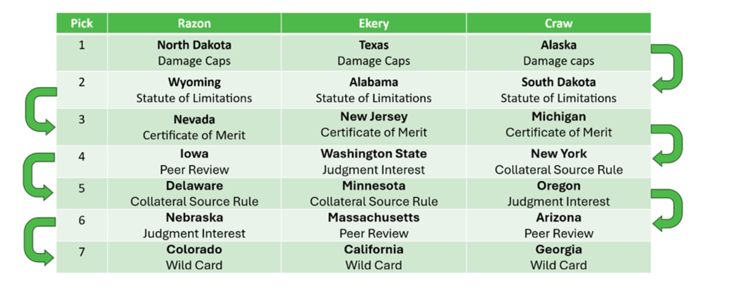
At the conclusion of the draft, our panelists were able to make a closing statement to convince the audience why their team was the best. The audience of almost 100 people then voted to pick the winner.
ProAssurance’s Laura Ekery was the top audience vote-getter. She drafted a great team and also benefited from the many ProAssurance MPL Association conference attendees who came to support us. Her prize was a statue of Rocky Balboa in honor of the meeting’s host city.




State Legislative Updates
Key State Legislative Updates
State general assemblies were active in the 2025-2026 legislative session passing laws focused on regulating healthcare consolidation, expanding health insurance coverage, and modifying Medicaid, many in response to federal changes enacted in the “One Big Beautiful Bill Act of 2025.”1 Many states prioritized tightening restrictions on pharmacy benefit managers, enhancing price transparency, and lowering prescription drug costs. Virginia defeated a surprise bill proposing a significant increase in the medical malpractice cap, while other states concentrated their efforts on increasing access to telehealth and removing medical debt as a measure of creditworthiness. States took a mixed approach to reproductive services, with some strengthening access while others proposed restrictions.
Bills Enacted into Law in 2025-2026
The state legislative process begins when a bill is drafted, sponsored, and introduced by a member of the House of Representatives or the Senate. After a formal committee review and research phase, the bill is placed on the legislative calendar for floor debate and a vote. If passed by a majority vote in both chambers, the measure is sent to the Governor for executive action, which may include signing it into law, allowing it to become law without a signature, issuing a veto, or returning it with recommended amendments.
The following bills were enacted into law in the 2025-2026 session and may impact your clients, the patients they care for, or the medical malpractice insurance space.
Title: Consent to medical treatment; age at which minor may consent to medical treatment revised, exceptions further provided for.
Summary: This bill raises the age of medical, dental, and mental health consent for minors from 14 years old to 16 years old. The law requires written parental permission for services and access to records for minors under 16. Minors under 16 can still consent to services related to sexually transmitted diseases, substance abuse, or in medical emergencies.
Statute No.: SB 101 is now Acts No. 2025-455; Ala. Code 1975 §§ 16-22-16.2, 22-8-4, 22-8-6, 22-8-9, 22-8-10, 22-8-12, 22-8-12, 22-8-12, 22-8-13, 22-8-14.
Title: Medicaid Agency, colorectal cancer screening test, coverage required for test based on grade A or B recommendation from U.S. Preventative Services Task Force.
Summary: This act requires Medicaid coverage for certain noninvasive colorectal screening tests and colonoscopies based on a positive test result. It is scheduled for automatic repeal on October 1, 2027.
Statute No.: HB 45 is now Ala. Acts No. 2025-446; Ala. Code 1975 § 22-6-15.
Title: The David "Mac" McElhaney and Roy S. Johnson Prostate Cancer Prevention Act.
Summary: This act requires Medicaid coverage for prostate cancer screenings at no cost to men who are at high risk or carry a genetic marker for prostate cancer.
Statute No.: SB 19 is now Ala. Acts 2026-130; Ala. Code 1975 §§ 27-58-1, 27-58-4.
Title: California Health Care Quality and Affordability Act.
Summary: These amendments increase state oversight and reporting obligations of healthcare transactions involving private equity, hedge funds, and management services organizations (MSOs). They also strengthen restrictions for private equity and hedge funds involved with a physician or dental practice, preventing them from interfering with the provider’s professional healthcare decisions.
Statute No.: Ca. Health and Safety Code §§ 127500.2, 127501, 127507, 127501.5.
Title: Health facilities.
Summary: This amendment codifies existing Corporate Practice of Medicine (CPOM) restrictions including prohibiting interference with healthcare professional judgment and control over healthcare operations by hedge funds or MSOs.
Statute No.: Ca. Health and Safety Code §§ 1190 et seq.
Title: Health care coverage; insulin.
Summary: This amendment prohibits health payments for insulin from exceeding $35 per month for individual and small group plans. It also mandates coverage for glucose monitors, testing strips, and other diabetic supplies.
Statute No.: Ca. Health and Safety Code § 1367.51; Ca. Insurance Code § 10176.61.
Title: Privacy: health data: location and research.
Summary: This amendment strengthens privacy protections for those seeking reproductive healthcare and prohibits geofencing at family planning centers in California.
Statute No.: Ca. Civil Code §§ 1798.99.90, 1798.99.91, 1798.99.92, 1798.99.93; Ca. Health and Safety Code § 140.
Title: Sexual and Reproductive Health Care.
Summary: This amendment reinforces legal protections for healthcare professionals for sexual and reproductive healthcare services. The law prohibits state and local authorities from taking legal action against healthcare providers, clinics, and other professionals who manufacture, transport, distribute, or provide medications like mifepristone. The legislation protects healthcare professionals from criminal prosecution for providing abortion-related services that are legal in the state. It also protects health insurance coverage for these drugs.
Statute No.: Ca. Health and Safety Code, §§ 1367.21, 1375.61, 111480, 1220.2, 1265.12 111376; Ca. Bus. and Prof. Code §§ 2519, 2761, 2878, 4076, 4521, 687, 850.3, 4318; Ca. Civil Code § 56.110; Ca. Family Code § 6925; Ca. Insurance Code §§ 10123.195, 10133.641; Ca. Penal Code §§ 3405, 4028; Ca. Welfare and Institutions Code §§ 220, 1773.
Title: Pharmacists: furnishing contraceptives.
Summary: This bill expands pharmacy laws to allow pharmacists to dispense birth control without a prescription.
Statute No.: Cal. Bus. and Prof. Code §§ 733, 4052, 4052.3, 4064.5.
Title: An Act to Amend Titles 10, 11, 18, 24, and 29 of the Delaware Code Relating to Healthcare Services.
Summary: These amendments clarify “healthcare services” and protect healthcare providers from adverse actions for providing legally allowed reproductive and fertility care to out-of-state patients.
Statute No.: Del. Code Ann. Title 24 §§ 1702, 1731, 1773, 1922; Title 10 §§ 3928, 3929; Title 18 § 2535; Title 29 § 611.
Title: An Act to Amend Title 6 of the Delaware Code Relating to the Medical Debt Protection Act.
Summary: This amendment prohibits the reporting of medical debt to a consumer reporting agency and the use of medical debt information to make decisions related to someone’s credit, housing, or employment.
Statute No.: Del. Code Ann. Title 6 §§ 2502J, 2507J.
Title: An Act relating to Stem Cell Therapy.
Summary: This act allows licensed physicians to administer certain non-FDA-approved adult stem cell therapies for orthopedics, pain management, and wound care and specifies requirements of facilities in which physicians obtain stem cells for therapy.
Statute No.: Fla. Stat. §§ 458.3245, 459.0127.
Title: Advanced Practice Registered Nurse Services.
Summary: This bill authorizes APRNs to file a death certificate and certify cause of death and revises the definition of primary or attending practitioner.
Statute No.: Fla. Stat. § 382.008.
Title: Refund of Overpayment Made by Patients.
Summary: This bill requires practitioners to refund patient overpayments within 30 days of recognition or risk administrative fines and disciplinary action. Excluded are overpayments made to providers by commercial insurers or HMOs.
Statute No.: Fla. Stat. §§ 408.12, 408.813, 456.0625, 456.072.
Title: Compounding drugs; registration of medical spas.
Summary: This bill establishes a regulatory framework for medical spas and requires they register with the medical licensing board by January 1, 2027, or risk fines up to $5,000. The licensing board is required to establish and maintain a public database of registered med spas. In the case of a serious adverse event, med spas are required to notify the board no later than five days following the event. The law also prohibits provision of services outside of the medical spa premises. Additionally, this law requires sellers and distributors of compounded drugs to keep specific records and requires the Indiana Department of Health to report on compounding oversight and risks.
Statute No.: SB 282 is now Public Law 136-2026; Ind. Code §§ 16-18-2-41.2, 16-18-2-66.8, 16-42-22.5, 25-22.5-12.5, 25-26-13-4.
Title: Physician noncompete agreements.
Summary: This act bans non-compete agreements between physicians and hospitals or affiliated entities on or after July 1, 2025. It serves to lift restrictions on physicians to practice medicine in certain geographic areas or for a designated length of time after ending the employment relationship with a hospital.
Statute No.: SB 475 is now Public Law 207-2025; Ind. Code §§ 25-22.5-5.5-1.1, 25-22.5-5.5-1.2, 25-22.5-5.5-1.3, 25-22.5-5.5-1.4, 25-22.5-5.5-1.6, 25-22.5-5.5-1.7, 25-22.5-5.5-2.3.
Title: Prior Authorization.
Summary: This bill provides that a claim for reimbursement of covered services may not be denied based solely on the provider being out of network. It also prohibits insurers from requiring prior authorization for the first 12 physical therapy or chiropractic visits for each new episode of care.
Statute No.: SB 480 is now Public Law 144-2025; Ind. Code §§ 5-10-8-19, 27-1-37.5.1 – 27-1-37.5-28; 27-1-37.5-11; 27-8-5.7-12, 27-13-36.2-10.
Title: Preserve Telehealth Access Act of 2025.
Summary: This act extends audio-only telehealth to include phone conversations and reimbursement parity for both Medicaid and commercial insurers. It provides reimbursement at the same rate as in-person care. It also restricts the circumstances under which a provider is authorized to prescribe controlled substances for certain conditions through telehealth.
Statute No.: HB 869 is now Chapter 482; Md. Code Ann., Health-Gen. § 15-141.2, 19-108.6, Md. Code Ann., Health Occ. § 1-1003, Md. Code Ann., Ins. § 15-139.
Title: Fair Medical Debt Reporting Act.
Summary: This bill prohibits consumer reporting agencies, healthcare facilities, a health care practitioner, or an ambulance service from disclosing certain medical debt in a consumer report.
Statute No.: HB 1020 is now Chapter 121; Md. Code Ann., Commercial Law § 14-1213; Md. Code Ann., Health-Gen. §§ 19-214.2, 24-2501 et seq.
Title: Health Insurance - Individual Market Stabilization - Establishment of the State-Based Health Insurance Subsidies Program.
Summary: This act establishes a state-based health insurance subsidies program to supplement reductions in federal premium tax credits for calendar years 2026-2028.
Statute No.: HB 1082 is now Chapter 468; Md. Code Ann., Ins. §§ 31–107, 31-125.
Title: The Doula and Birth Policy Transparency Act.
Summary: This act requires hospitals to provide evidence to the Maryland DOH that they have certain obstetric policies in place, and it requires medical professional liability (MPL) insurers to provide the DOH with liability policy information regarding an obstetrician’s coverage of services upon request.
Statute No.: HB 1251 is now Chapter 751; Md. Code Ann., Health-Gen. §§ 19-2601 et seq; Md. Code Ann., Ins. § 19–104.1.
Title: The “Momnibus” Bill Package.
Summary: This act is a package of 10 individual bills designed to improve support for prenatal and maternal healthcare and to decrease racial disparities in outcomes. These bills expand coverage for midwifery and doula services, mandate postpartum mental health screenings, and expand access to substance use disorder treatment and related support services. The legislation also establishes reporting and data collection requirements to improve transparency in maternal health outcomes and facilitate targeted interventions. In addition, it supports workforce development initiatives and allocates funding to community-based organizations focused on maternal and infant health, particularly in underserved populations, to address social determinants of health and improve continuity of care throughout pregnancy and the postpartum period.
Statute No.: Mich. Compiled Laws §§ 333.2227, 333.2617, 333.2617a, 333.2617b, 333.2618; 333.20201, 333.21513, 333.21537; 500.2434; 700.5507, 700.5509; 37.2201, 37.2301; 333.2701, 333.2705, 333.2709, 333.2723; 500.3406cc; 400.109; 400.109q, 400.109r.
Title: Right to Contraception and Family Planning Services Act.
Summary: This bill revises provisions relating to family planning services. It prohibits state and local governments from restricting access to birth control and other services. It aims to ensure access to services remains the same even if federal laws change.
Statute No.: Nev. Rev. Stat. §§ 449a.140-148.
Title: Medical malpractice information disclosures; report.
Summary: This law is a compromise, following the Senate’s rejection of the House-passed bill to raise the state’s medical malpractice cap from $2.7 million to $6 million. This version dispenses with the change in cap and mandates medical malpractice insurers and self-insured hospitals and healthcare systems submit detailed data on premiums, claims, settlements, and litigation costs to the Bureau of Insurance by October 1, 2026.
Statute No.: Va. Code Ann. § 8.01-581.15:1.
Title: Hospitals; reports of threats or acts of violence against health care providers.
Summary: This bill requires healthcare employers to implement workplace violence prevention plans and reporting systems. The law requires reporting of data collected to the Chief Medical Officer and Chief Nursing Officer on a quarterly basis and that a report is sent to the DOH annually that includes the number of incidents of workplace violence reported by staff.
Statute No.: Va. Code Ann. § 32.1-127.
Title: Virginia Birth-Related Neurological Injury Compensation Program and Fund; filing of claims.
Summary: These companion bills amend the Virginia Birth-Related Neurological Injury Compensation Program. This act stipulates the establishment and operation of the birth injury compensation fund. Increases the potential award through the program from $100k to $500k.
Statute No.: Va. Code Ann. §§ 38.2-5002, 38.2-5002.1, 38.2-5004, 38.2-5005, 38.2-5006, 38.2-5007, 38.2-5009, 38.2-5009.1, 38.2-5015, 38.2-5016, 38.2-5017, 38.2-5020.
Title: APRN Modernization Act.
Summary: The legislation creates a new nursing licensure category for APRNs and allows them to practice independent of a physician collaborative agreement contingent upon meeting practice hours and other requirements including carrying medical professional liability insurance.
Statute No.: AB 257 is now 2025 Wis. Act 17; Wis. Admin Code §§ 146.89, 253.13, 255.06, 441.06, 441.11, 29.193, 45.40, 46.03, 50.08, 50.09, 50.49, 51.41, 70.47, 77.54, 97.59, 106.30, 118.15, 118.25, 118.29, 118.2915, 118.2925, 118.294, 146.615, 146.82, 154.01, 252.07, 252.10, 252.11, 252.15, 252.16, 252.17, 253.07, 253.115, 253.15, 255.07, 257.01, 341.14, 343.16, 343.51, 343.62, 440.077, 440.094, 440.981, 440.982, 440.987, 441.01, 441.07, 441.10, 441.18, 448.03, 448.035, 448.56, 448.62, 448.67, 448.956, 450.0, 450.03, 450.11, 450.13, 450.135, 462.04, 655.001, 655.002, 655.003, 655.005, 655.23, 655.27, 655.275, 895.478, 961.01, 961.395, 155.01, 251.01, 440.03, 440.08, 441.001, 441.065, 441.09, 441.092.
Title: Informed Consent for Pelvic Examinations.
Summary: This law requires hospitals to have a policy and process to obtain written informed consent for pelvic exams performed solely for educational purposes while a patient is under anesthesia or otherwise unconscious.
Note: Wis. Stat. § 50.373.
Information regarding Georgia and New Mexico’s comprehensive tort reform can be found in our April issue, Take It to the Limit | ProVisions.
States to Watch in 2026-2027
Key legislative trends for the 2026-2027 cycle focus on increasing protections for minors, broadening recovery of damages, and extending the statute of limitations in MPL cases. In attempts to mitigate barriers to care due to physician shortages, especially in rural communities, additional states have proposed legislation to authorize independent practice for PAs and APRNs.
SB 918 makes changes to admissibility of expert testimony. This bill would strengthen the standards applicable to the provision of expert witness testimony.
SB 258 and HB 449 are companion bills that create The Better Access to Health Care Act.
This bill proposes eliminating the Standard Care Arrangement (SCA) and allows for APRNs to practice without a collaborative agreement.
HB 2088 amends several provisions of MCARE. This amendment would update MPL law definitions and expert qualifications for those providing professional opinions and reviews and supporting certificates of merit.
HB 404/HB 535/HB 618/HB 755 are a group of bills that would codify ACA protections. These bills would enshrine key ACA provisions like coverage for young adults up to the age of 26 years old, prohibiting coverage caps on annual or lifetime dollar limits, protecting those with pre-existing conditions, and requiring insurers to cover preventive health services without cost sharing.
AB 1011 addresses recovery of noneconomic damages in medical malpractice lawsuits.
This bill would increase the noneconomic damages cap from $750 thousand to $3 million. It failed to pass the Senate last session but could find its way back on to the calendar this year.
General Resource: National Conference of State Legislatures Database
Conclusion
This update summarizes many new statutes and pending bills, but it is not exhaustive. Laws related to reproductive health services and gender-affirming care are evolving rapidly. Please consult your state medical society and state legislative website for the most current guidance on these topics and evolving legislation.
Federal Healthcare Policy Updates Shaping
Medical Malpractice in 2026
As 2026 healthcare policies take effect, several regulatory and legal developments are poised to influence medical professional liability—some by shaping care delivery and others by changing how claims are litigated.
Below are most relevant federal changes likely to impact exposure and claims activity.
Obstetric Care Standards
The Centers for Medicare & Medicaid Services (CMS) is implementing new requirements for hospitals that provide obstetric services, aimed at standardizing and improving maternal care. Facilities must ensure care aligns with nationally recognized standards, with consistent quality across both inpatient and outpatient settings. The rule also sets clearer expectations around staffing, supervision, provider qualifications, available equipment, and emergency preparedness. An additional phase taking effect in 2027 will focus on staff training.
These more defined expectations may serve as a reference point in litigation, giving plaintiffs a clearer framework for alleging that care fell below accepted standards. They may also increase scrutiny around staffing decisions, clinical readiness, and how obstetric emergencies are managed.
Affidavit of Merit Ruling
On January 20, 2026, the U.S. Supreme Court issued its unanimous decision in Berk v. Choy. The Court held that Delaware’s state affidavit of merit (AOM) requirements, which have long served as an early screen for meritless malpractice cases, do not apply in federal court when cases are filed under diversity jurisdiction. It found that plaintiffs need only to provide a “short and plain statement of the claim” when filing a malpractice lawsuit, effectively removing required expert affidavits.
While the holding is expressly about Delaware’s statute, litigants may cite the Court’s analysis in disputes involving other states’ AOM requirements. The decision is expected to encourage forum shopping into federal venues, particularly where state requirements are more stringent, and may increase early-stage defense costs and discovery exposure.
Ultimately Berk v. Choy may have implications for coverage pricing, defense reserves, and claims handling for any insured practicing in a state affected by this ruling.
TEAM Model
Effective January 1, CMS has launched the Transforming Episode Accountability Model (TEAM), which will hold more than 700 hospitals financially responsible for the quality and cost of care tied to five major surgical procedures for 30 days after discharge. The procedures include (1) coronary artery bypass graft surgery; (2) lower extremity joint replacement; (3) major bowel procedure; (4) surgical hip and femur fracture; and (5) spinal fusion.
In response, many organizations are focusing on tighter coordination with post-acute providers and more standardized care pathways. Although the model does not set clinical standards, the increased emphasis on consistency and care coordination may influence how care decisions are evaluated. As treatment approaches become more standardized, deviations—particularly those tied to complications or readmissions—could face greater scrutiny in litigation.
Outpatient Care
CMS is implementing several hospital payment updates in 2026, including modest increases to outpatient reimbursement for facilities that meet quality reporting requirements. At the same time, the agency is accelerating the shift of many procedures from inpatient settings to outpatient departments and ambulatory surgery centers, while also aligning payment rates across care settings.
From a medical malpractice perspective, the migration of more complex procedures to outpatient settings may increase scrutiny around whether the chosen care location was appropriate, particularly if complications arise. Additionally, expanded price transparency could introduce new considerations in litigation, as plaintiffs may use pricing data to question decision-making, resource allocation, or potential financial influences on care.
Prior Authorization Changes
Starting in 2026, CMS is requiring insurance payers, including Medicare Advantage, Medicaid, and CHIP plans, to make prior authorization decisions faster than before: within 72 hours for urgent requests and within seven calendar days for routine ones. When they deny a request, they must now give a specific reason why. Payers also have to publicly report data on their prior authorization activity, making the process more transparent.
These changes aim to create a more robust administrative record of when and why care was approved or denied, which can be critical evidence in cases where a patient alleges that a treatment delay caused harm. If a provider can show they sought timely authorization and a payer failed to meet the new deadlines, that documentation may help shift liability toward the payer rather than the clinician.
WISeR Model
CMS has also launched a six-year pilot program called the Wasteful and Inappropriate Service Reduction (WISeR) Model, running through the end of 2031 in six states: New Jersey, Ohio, Oklahoma, Texas, Arizona, and Washington.
The program is voluntary and aims to reduce unnecessary care in traditional Medicare by using artificial intelligence and machine learning to help reviewers decide whether certain outpatient services, such as skin and tissue substitutes, electrical nerve stimulators, and knee arthroscopy, should be approved. Importantly, all actual coverage denial decisions must still be made by a licensed clinician using evidence-based criteria. The model applies to traditional Medicare only and does not change existing coverage or payment rules.
Because the model financially incentivizes participating organizations to reduce services deemed unnecessary, there is a potential tension between cost-cutting goals and individual patient care decisions. Further, if a denial leads to delayed or foregone treatment that results in patient harm, questions about who bears liability (the reviewing clinician, the participating company, or the treating provider) are largely unsettled. The requirement that licensed clinicians make all denial decisions offers some procedural protection, but as AI plays a larger role in flagging services for review, malpractice litigation in this space may evolve quickly.
Coverage Disruptions
The expiration of enhanced ACA subsidies that made insurance more affordable expired at the end of 2025. These subsidies, which had been in place since 2021, helped keep premiums manageable for a wide range of Americans. Now an estimated 4.8 million people are expected to lose coverage as a result.
Lack of insurance is closely associated with delayed or foregone care. As more individuals lose coverage, delayed diagnosis and treatment are likely to increase, which may contribute to greater claim severity. In addition, when uninsured or underinsured patients do seek care, it is often in emergency settings where conditions have progressed, increasing clinical complexity and the risk of adverse outcomes. For providers, a rise in uncompensated care can also create financial strain that can affect staffing and resources—factors that have historically correlated with increased malpractice exposure.
While only a subset of these changes directly affects clinical standards, others are likely to influence how claims are filed, defended, and ultimately resolved. We will continue to monitor these developments throughout the year.
State-Level AI Legislation & Guidance Round-Up
“AI is no longer an experiment.” - Cleveland Clinic Chief AI Officer Ben Shahshahani, PhD
AI in healthcare is no longer just a possibility. It is already in use in many hospitals and clinics. With AI tools now impacting numerous aspects of healthcare including diagnosing, tracking patient health, personalizing care, streamlining administrative tasks, and more, researchers are raising potential ethical concerns about patient privacy and use of AI in healthcare settings.*
State legislators, too, are reacting with new and expanded laws to regulate the use of these new tools and their impact on patients and the healthcare system. Here’s a rundown of some of these laws.
CURTAILING AI-BASED ALGORITHMIC BIAS AND DISCRIMINATION
Legal Advisory on the Application of Existing California Law to Artificial Intelligence in Healthcare
Issued by CA Attorney General on January 13, 2025
The California Attorney General issued a legal advisory aimed at healthcare providers and all other entities that interact with the healthcare system. The AG asserted that AI systems that disproportionately impact protected classes (e.g., race, sex, age, disability) may violate state anti-discrimination laws, including Government Code Section 11135, which prohibits discrimination by entities receiving state support, such as Medi-Cal. The AG highlighted concerns over algorithmic bias, where AI-driven decisions may result in the denial of services to certain individuals.
Colorado Anti-Discrimination in AI Law (ADAI)
Approved May 17, 2024; Effective June 30, 2026
In Colorado, developers and users of “high-risk” AI systems are required to exercise reasonable care to prevent algorithmic discrimination when such systems are used to make or substantially support consequential decisions, including in healthcare and insurance. The legislation also mandates transparency, requiring disclosures to consumers about the use of such high-risk AI systems.
Protecting Consumers from Unfair Discrimination in Insurance Practices (SB21-169)
In effect as of July 6, 2021
Colorado requires insurers to ensure that algorithms and predictive models, which may use AI, do not result in unfair discrimination, and it requires governance, testing, and corrective action to address discriminatory outcomes.
REQUIRING HUMAN INVOLVEMENT IN AI-ASSISTED HEALTH INSURANCE CLAIMS
Denial Restrictions (HB 2175)
Signed May 12, 2025; Effective July 1, 2026
In Arizona, a medical director must perform an individual, manual review of any claim or prior authorization denial based on medical necessity and may not rely solely on recommendations from any other source, effectively forbidding reliance solely on AI recommendations.
Physicians Make Decisions Act (SB 1120)
In effect as of January 1, 2025
California prohibits health insurers from using AI as the sole basis for denying, delaying, or modifying requests for care based on medical necessity, requiring a licensed physician or qualified professional to make the final determination.
Payment of Health Claims (HB 1271)
In effect as of July 1, 2026
In Indiana, a provider is prohibited from using an automated process, system, or tool to submit a health benefits claim without the review of a provider or other person involved in the development of the claim for submission.
This legislation prohibits an insurer from using an automated process, system, or tool as the sole basis for downcoding a claim based on medical necessity, without a human review of the medical record. It also requires an insurer to disclose when AI is used to make an adverse determination on a prior authorization or request or to downcode a claim.
Kentucky requires licensed physicians to make utilization review decisions to deny, reduce, or limit benefits, effectively prohibiting reliance on AI determinations.
Reporting Requirements & AI Governance (Md. Code, Ins. §§ 15-10A-06, 15-10B-05.1)
In effect as of October 1, 2025
In Maryland, health insurers must report adverse claims decisions, noting whether AI or automated tools were used. These statutes impose extensive governance requirements on AI use to ensure clinical relevance, human oversight, and non-discrimination.
REVIEWING AND DISCLOSING AI-GENERATED CONTENT
Artificial Intelligence in Healthcare Services Bill (AB 3030)
In effect as of January 1, 2025
In California, clinics, physician offices, and health facilities that use generative AI to produce patient communications must include a clear disclaimer that the message was created by AI and provide instructions on how patients can contact a human healthcare professional.
Artificial Intelligence In Electronic Health Record (SB 1188)
In effect as of September 1, 2025
A healthcare practitioner who uses AI for diagnostic purposes, including the use of AI for recommendations on a diagnosis or course of treatment based on a patient's medical record, shall review all records created with AI in a manner that is consistent with Texas Medical Board medical records standards. A healthcare practitioner who uses AI for such diagnostic purposes must disclose the practitioner’s use of that technology to the practitioner's patients.
* Cleveland Clinic. “How AI Is Being Used in Healthcare—and What It Means for You.” December 22, 2025.
![]() |
![]() |
![]() |
The Intelligent Producer
No matter which of the 50 states you reside in, one thing is clear: artificial intelligence (AI) is rapidly becoming a differentiator for insurance agencies competing in an increasingly saturated marketplace. The advantage will belong to firms that apply AI to identify prospect needs earlier, strengthen client relationships, and reclaim time for higher-value opportunities.
As new AI-native platforms emerge daily, seasoned professionals have a timely opportunity to modernize operations with practical, incremental improvements. The ideas below outline a phased approach—starting with low-friction enhancements and expanding toward deeper, longer-term capabilities.
Ease: Low | Timeline: Short
- Document summarization — Convert lengthy policy forms into concise, client-ready executive summaries that clearly highlight year-over-year changes.
- Gap analysis and automated proposals — Compare expiring coverage to current exposures to surface cross-sell opportunities (e.g., higher limits, cyber, or regulatory defense endorsements) and streamline renewal discussions.
- Predictive risk scoring — Use claims and engagement signals to flag accounts with elevated loss potential or churn risk so teams can prioritize retention and profitability.
These capabilities typically require minimal infrastructure and can leverage data that agencies already maintain.
Ease: Low–Medium | Timeline: Short to Medium
- Trigger-based lead generation — Monitor public signals (e.g., NPI registrations, job postings, practice expansions, and facility filings) to identify high-intent prospects before competitors engage them.
- Web presence analysis — Review prospect websites and social profiles to detect new services, locations, or specialties that may create coverage gaps or new placement opportunities.
- Indicative quoting — Use available public and third-party data to produce rapid, preliminary risk indications that enable faster, more relevant initial outreach.
- Submission triage and data enrichment — Screen applications against carrier appetite, enrich submissions with third-party attributes, and reduce manual review time.
Ease: Medium–High | Timeline: Medium to Long
- Compliance assistant — Provide real-time guidance on surplus lines statutes and multi-state filing requirements to reduce manual research and improve consistency.
- Interactive SOP assistant — Replace static manuals with conversational, agency-specific workflow guidance (e.g., “How do I process a mid-term surgeon addition in Epic?”).
- Workflow gap detection — Map submission and renewal pipelines to pinpoint where deals stall, handoffs break down, or cycle time expands.
- Predictive revenue forecasting — Apply submission-to-bind ratios and historical retention trends to build 12-month projections and support “what-if” scenario planning.
These initiatives typically require curated datasets and additional development time, but they can deliver durable operational efficiency.
Final Thoughts
AI does not require a wholesale infrastructure overhaul; it requires a disciplined sequence. Begin where reliable data already exists, create momentum through quick wins, and then expand into more advanced use cases as governance and integration mature. Agencies that experiment now will be better positioned to scale these capabilities as tools—and expectations—continue to evolve.
![]() |
![]() |
Virginia’s Most Recent Effort to Increase Damages Caps Gets Rejected
In recent years, the Virginia Legislature has considered various proposals to modify or eliminate the medical malpractice damages cap, but those efforts have thus far been unsuccessful. The damages cap is currently at $2.7M, and scheduled annual increases would put the cap at $3M by July 2031 with prejudgment interest awarded inside the cap.1
The stability provided by the cap was challenged again on January 14, 2026, when Sen. Mark Obenshain—an attorney whose law firm works on medical malpractice cases—introduced Senate Bill 536 (SB 536) to allow prejudgment interest to be awarded outside the cap. The bill passed unanimously in the Senate and was sent to the House of Delegates Courts of Justice Committee.1
Rather than putting SB 536 to a vote in the full House of Delegates, the Courts of Justice Committee indicated that the legislation would be used as a vehicle to address the malpractice cap.1 Shortly after receiving the Senate bill, the House announced a new proposal to more than double the cap. The House bill would raise the cap to $6M beginning in 2027 with bi-annual increases for inflation. It also extended the statute of limitations for when a plaintiff can bring a case against a provider.2
The Senate rejected the House’s modified bill.
A conference committee of six legislators was organized to develop a compromise bill. The result was something entirely different than what was expected: a bill that maintained the current caps but, according to Del. Patrick Hope, became “more of a data gathering exercise.” The final version of the bill requires medical malpractice insurers and healthcare providers protected under alternative risk plans to report a wealth of data to state regulators about insurance premiums, doctors covered under programs, claim payments, settlements, litigation costs, and more.3
That final bill was passed out of the General Assembly and was sent to the Governor for consideration on March 31. While opponents of a cap increase succeeded in keeping it out of the final bill, there were other issues with the legislation. The MPL Association, The Doctors Company, and other stakeholders submitted a joint letter to Virginia Governor Abigail Spanberger outlining concerns about the reporting obligations and requested several amendments:4
- Data should be reported to the State Corporation Commission’s Bureau of Insurance (the Bureau) rather than state legislative committees.
- The bill should allow the Bureau to interpret the reporting requirement to clarify the data points required.
- The Bureau should be required to issue a report on the data to help legislators understand what it really means.
On April 12, Governor Spanberger returned the bill to the General Assembly without signature, submitting instead an amendment to substitute for the original bill (known as an amendment in the nature of a substitute). The substitute included changes requested by industry stakeholders including that disclosure reports be submitted to the Bureau. The bill also included the analysis and reporting changes required of the Bureau as well as the requested confidentiality language and other changes. The amended bill was sent to the General Assembly for approval with the existing damages cap intact.
The sponsor of the original bill, Sen. Obenshain, noted, however, that the cap issue is likely to be revisited:
“The medical malpractice cap is under a lot of pressure, and I think unless we do something to address that pressure, we’re at risk of losing the cap altogether. I don’t think that’s a good thing.”3
While Del. Hope told local NPR affiliate, VPM, “There’s a recognition that [the cap is] too low,” he takes an optimistic view about the current bill’s reporting requirements:
“I think this is an opportunity for us to learn, and I think we’ll have even more information before us to make the right decision that has a balance between what’s fair for the patient and what’s fair for continued patient access and for our providers too.”3
The General Assembly passed the final amended and reconciled bill with the Governor’s revisions on April 22.
1. Joran Sequeira, “In a Late-in-Session Move, a Bill to Raise the Medical Malpractice Cap,” Virginia College of Emergency Physicians, March 3, 2026.
2. Charlotte Rene Woods, “Last-Minute Tweak to Bill Could Double Virginia’s Medical Malpractice Payment Caps for Plaintiffs,” Virginia Mercury, March 5, 2026.
3. Dean Mirshahi, “Medical Malpractice in Virginia Was Nearly Overhauled. What Happened,” VPM (Virginia Public Media), March 20, 2026.
4. MPL Association, et al., “Request for Changes to (VA) Legislation Mandating MPL Claims Reporting to State Legislature,” April 2, 2026.

State Profile Library
If you operate in 50 states, you operate in 50 different lines of business. Our state profiles provide a high-level review of key laws, regulations, and market share information that impacts the MPL environment in a given state. We encourage you to use each profile as a quick reference when working in a new state or territory.
Agents.ProAssurance.com/State-Profiles
While medical professional liability is a national industry, it is ultimately a state-based business. Each state is regulated by its own department of insurance, has its own laws and regulations, and has a unique operating environment that can have a significant impact on the business opportunities in the area. As agencies and brokerages continue to expand, it is increasingly common to need knowledge on the fly regarding the MPL industry in a state outside of your usual territory.
Your ProAssurance team is always available to answer questions or help you navigate a business opportunity. We especially encourage you to call on our regional staff, taking advantage of their significant knowledge and experience with specific states and territories.
MPL Industry Profile Data Sources
The regulatory, legal, and healthcare environments vary significantly from state to state, resulting in vast differences in the MPL markets in each location.
A variety of industry publications and reports were used to compile our state profiles:
- Market share information – SNL Insurance Statutory Market Share 2024 statistics
- MPL market mix – NAIC 2024 medical professional liability industry statistics
- Tort reform – Medical Professional Liability Association State Enactments of Selected Health Care Liability Reforms
- Prejudgment interest – White and Williams, LLP, comparative chart, verified with review of each cited legislative act
We will continue to update the profiles as new data becomes available to keep you informed. If you would like more information on a particular state, please contact your Business Development representative or let us know at AskMarketing@ProAssurance.com.
The Bind Order
This selection of accounts ProAssurance bound recently is intended to give our partners tangible examples of risk classes we’ve been successful quoting and that we’d like to see more of. These examples are anonymized with final premium rounded but otherwise present actual accounts.
ORTHOPEDIC SURGERY
Florida
Limits: $250k/$750k
Admitted
Premium: $59,000
DERMATOLOGY
Missouri
Limits: $1M/$3M
Admitted
Premium: $18,000
GENERAL SURGERY
New York
Limits: $1.3M/$3.9M
Admitted
Premium: $115,000
PATHOLOGY
California
Limits: $1M/$3M
Admitted
Premium: $4,100
GYNECOLOGY
California
Limits: $1M/$3M
Admitted
Premium: $36,000
UROLOGY
California
Limits: $2M/$4M
Admitted
Premium: $5,400
INTERNAL MEDICINE
Georgia
Limits: $1M/$3M
Admitted
Premium: $5,300
CONCIERGE MEDICINE
Georgia
Limits: $1M/$3M
Admitted
Premium: $7,200
EMERGENCY MEDICINE
California
Limits: $2M/$4M
Admitted
Premium: $103,000
NEPHROLOGY
Kentucky
Limits: $1M/$3M
Admitted
Premium: $98,000
ORTHOPEDIC SURGERY
Michigan
Limits: $1M/$6M
Admitted
Premium: $780,000
BEHAVIORAL HEALTH
Colorado
Limits: $1M/$3M
E&S
Premium: $8,500
AMBULATORY SURGERY CENTER
Florida
Limits: $250k/$750k
E&S
Premium: $16,000
THERAPY SERVICES
Indiana
Limits: $1M/$3M
E&S
Premium: $7,000
MEDICAL CLINIC
Alabama
Limits: $1M/$3M
E&S
Premium: $9,200
HOSPITAL
Ohio
Limits: $5M/$5M
E&S
Premium: $650,000
New Business Submissions
Our standard business intake address for submissions is Submissions@ProAssurance.com. For specialty lines of business, please use one of the following: CustomPhysicians@ProAssurance.com, Hospitals@ProAssurance.com, MiscMedSubs@ProAssurance.com, and SeniorCare@ProAssurance.com. Visit our Producer Guide for additional information on our specialty lines of business.
The types of business and premium amounts are illustrative of where we have written new business and not intended to reflect actual pricing or specific appetites.
Get all past editions of The Bind Order on our Marketing Materials page.
.png?width=300&name=MicrosoftTeams-image%20(28).png)

Three-quarters of American adults now get health care information from social media, according to a recent U.S. News and World Report analysis. A 2024 KFF Health Misinformation Tracking Poll found that two-thirds of adults use AI tools, with up to one-third doing so weekly. And the World Economic Forum’s 2024 Global Risk Report classified the spread of medical misinformation as a major global threat.
Featuring Jennifer Freeden, Southwest Regional Risk Manager (Risk & Insurance)
Casualty claims are becoming more expensive at a faster rate, but medical professional liability stands out as one casualty line where compounding factors are turning severity deterioration into a heightened risk.
According to an S&P Global Market Intelligence report, written by Husain Rupawala, Tim Zawacki, and Jason Woleben, medical professional liability “stands out as the most severity-pressured line in casualty insurance, with the highest figure across all lines.” (Insurance Journal)
The U.S. labor market is showing signs of strain, but the healthcare industry is experiencing a hiring boom and carrying much of the load.
Recent data shows that while hiring across the board is cooling, healthcare workers are still very much in demand, and more Americans are answering the call to work in the field. The U.S. economy added 76,000 jobs in healthcare in March, accounting for 43 percent of all new jobs. Last year, the sector added nearly 700,000 jobs, helping balance an otherwise weak hiring market. (Scripps News)
More than 5 million people are admitted to intensive care units every year. A 2025 study published in PLOS One suggests up to 54% of survivors may develop cognitive, physical and psychological impairments after an ICU stay. Older patients are often at higher risk for such symptoms. With an estimated 70% to 90% of adults now surviving ICU stays, this means the share of patients experiencing post-intensive care syndrome, or PICS, is growing. (Becker’s Hospital Review)
The Leapfrog Group highlighted broad improvements across several patient safety measures in this year’s spring release of hospital safety grades, the first reflecting changes made after a court-ordered removal of hospitals that declined to voluntarily submit information to the watchdog group.
Top marks were handed out to 917 hospitals, with Leapfrog outlining a particularly high share of “A” hospitals in the states of Connecticut (where 64% of hospitals received an “A”), Virginia (59%), South Carolina (51%), Utah (50%) and Montana (44%). (Fierce Healthcare)

Election-Year Uncertainty and Healthcare Buying Behavior

I remember a past election cycle when “healthcare reform” dominated the headlines. Almost every physician I called on asked, “Mace, what are you hearing about the election and reimbursement?” There was constant discussion about cost controls, restructured payments, and Medicare cuts. The market I served had a very high percentage of Medicare patients, so I was concerned as well.
The noise was enough to make me sell all my healthcare stocks. Prices were falling, and it felt prudent at the time. Shortly after the election, however, they bounced back. I missed the rebound.
Whether those fears were justified isn’t the point. What matters is that fear and uncertainty change thinking and behavior. Physicians who were previously receptive to exploring new products suddenly became cautious. Conversations that once centered on clinical improvement shifted toward financial concerns and practice survival.
I didn’t expect this to affect my sales. Surgeons weren’t responsible for paying for the products I sold; hospitals were. Yet as the election approached, I repeatedly heard the same phrase: “Let’s wait until after the election.”
The issue wasn’t policy. It was uncertainty—and uncertainty changes how people make decisions.
Political Noise Alters Psychology Before Policy
We see this pattern repeatedly. Even before a regulation changes, anticipation begins influencing behavior.
I see it in my business today. Healthcare manufacturers and distributors, who are normally eager to book me for keynotes and workshops, defer spending as an election approaches. Markets fluctuate. Expansion plans pause. Investors wait for clarity. The overall tone shifts from growth to caution.
When the future feels unclear, focus shifts from growth to protection. People conserve, both financially and psychologically.
In my article last month in ProVisions, I discussed how decision fatigue impacts physician buying behavior. Few factors reduce decision bandwidth as much as financial uncertainty does. When it rises:
- Buyers narrow decisions to what feels essential.
- Optional changes get postponed.
- Sensitivity to downside risk increases.
Even before anything officially changes, behavior does.
What This Means for MPL Agents
With 2026 approaching as an election year, legislative conversations will intensify. Healthcare will be debated loudly, and clients are likely to have questions.
It’s not your job to talk politics with clients (just don’t!). Nor is it your role to analyze every proposed bill or forecast every outcome. But understanding how uncertainty reshapes decision-making can strengthen your conversations.
Here are a few patterns to anticipate:
- Longer decision cycles. A delayed decision may have nothing to do with dissatisfaction. During uncertain periods, “wait and see” becomes a default strategy.
- Reduced tolerance for urgency. When financial concerns rise, pressure-based tactics can backfire. Clients tend to value clarity and steadiness more than rapid change.
- Increased need for reassurance. Political conversations may spark concern, but the underlying questions are usually about exposure, protection, and managing downside risk.
Selling Stability in Unstable Times
You might say you sell MPL insurance, but what you really sell is stability. HCPs need to trust that you will anticipate their needs, be reliable, and have the knowledge to guide them through any surprises.
In stressful seasons, success isn’t about adding urgency (election years supply plenty of that). It’s about reducing noise, respecting timing, and providing steady reassurance that your clients are protected, regardless of what the headlines are debating.

|
Written by Mace Horoff of Medical Sales Performance. Mace Horoff is a representative of Sales Pilot. He helps sales teams and individual representatives who sell medical devices, pharmaceuticals, biotechnology, healthcare services, and other healthcare-related products to sell more and earn more by employing a specialized healthcare system. Have a topic you’d like to see covered? Email your suggestions to AskMarketing@ProAssurance.com. |

Our 50th Year

![]() Then ➡️ Now Marcy Angulo Southwest Regional Senior Claims Associate, Claims Department Celebrating 32 years in 2026
|

![]() Then ➡️ Now Jeff Kruger Lead Claims Specialist, Claims Celebrating 33 years in 2026
|
Dari Paulus, Broker Strategies Manager [not pictured]
Dari began her time at the Company with Pennsylvania Medical Society Liability Insurance Company (PMSLIC), which was later acquired by NORCAL. Celebrating 39 years in 2026.

My time visiting the Mechanicsburg office; it was a great visit. It was impressive to see the honey bees in the Birmingham office too! – Marcy
Driving from Springfield, Missouri, to Kansas City after a mediation, defense counsel and I started hearing tornado warnings on the radio. Defense counsel assured me our route was safe, but later became more concerned when the warning was updated. “That is right near my house!" By the time we exited the freeway in Kansas City, the rain was coming down in sheets, sirens filled the air and this Californian was pretty freaked out. We parked in a restaurant's underground garage and took shelter. When the "all clear" was sounded, we proceeded to the restaurant for happy hour with defense counsel's colleagues. Apparently, just another day in Kansas City, but not one I will soon forget! – Jeff
After more than 39 years, it’s difficult to single out just one favorite memory or moment. What I will always cherish, though, are the people I’ve had the privilege to work alongside—those who have taught me so much and played such an important role in shaping who I am today. – Dari
Being able to learn from my peers in my team, and continued time together with each of them has been rewarding over the years. – Marcy
When physicians express gratitude and relief for advice or information I have provided. – Jeff
The most rewarding part has been how much I’ve grown. I’ve gained confidence, picked up new skills, and taken on challenges that I wouldn’t have been ready for when I started. – Dari
Lots of developing experiences for me over the years, growth and personal development, opportunities in management, new experiences opened up that changed my role and the role of my department, that allowed growth and development we continue to appreciate from our coworkers. It's been fulfilling. – Marcy
Paper has essentially disappeared. – Jeff
Technology. When I first started, everything was done on a typewriter—documents were printed and filed in paper folders, stored in a file room that we locked up every night before leaving the office. – Dari
Stay focused, always complete your tasks, participate whenever possible. – Marcy
You will learn more from your mistakes than your successes in your early years. Get comfortable with shades of gray because there are not many "black and whites" when handling claims! – Jeff
Stay curious and never stop learning—every task, challenge, and interaction is an opportunity to grow. Don’t be afraid to ask questions or seek guidance; the people around you are one of your greatest resources. – Dari
About NORCAL Mutual
NORCAL Insurance Company (also formerly known as NORCAL Mutual Insurance Company or NORCAL Group) is a leading provider of medical professional liability insurance and risk management solutions for healthcare providers. Founded in 1975 and headquartered in San Francisco, NORCAL has operated as a wholly-owned subsidiary of ProAssurance Corporation since May 2021.

Risk Management Updates
RAPID RISK REVIEW PODCAST
Bridging the Gap: Navigating the Time Between an Event and Legal Support
An unexpected clinical outcome can trigger a cascade of emotions and professional uncertainty. In this high-stakes environment, the minutes and hours immediately following an event are often the most defining for your future liability and peace of mind.
In this episode, we are joined by Adam Draney, Director of Claims at ProAssurance, to discuss the "Pre-Counsel Gap"—the crucial, often chaotic window of time between an adverse event and the formal assignment of legal defense. Adam pulls back the curtain on the claims process, offering practical, expert-vetted guidance on how physicians should conduct themselves to protect their patients, practices, and professional reputations.


Allegation
The patient alleged failure to diagnose malaria, resulting in delayed treatment, prolonged hospitalization and amputation of multiple toes.
Read the issue

Medication errors remain among the most common, preventable patient harm events, due to organizational issues, technological factors, and communication breakdowns. More specifically, medication errors fall into two main categories—acts of omission and acts of commission.
Read the issue

In this episode, we examine an innovative group-based model for well-child visits that reimagines how pediatric care is delivered. Joined by pediatrician Dr. Michelle Gallas, the discussion explores how shared medical appointments bring parents together to navigate common developmental milestones, exchange practical insights, and build a sense of community that extends beyond the clinic walls.
Listen now

The deceased maternal patient’s family alleged that the labor and delivery team failed to appropriately manage a postpartum hemorrhage which caused the patient’s death.
Read the issueAmid rising reports and legal claims, physician sexual misconduct remains a serious challenge. Upholding ethics is essential, and doctors must navigate increasing scrutiny while maintaining trust and compassionate care for patients.

Read the issueKeep Up-to-Date on All Our Risk Management Resources
Our weekly risk management newsletter features the latest releases from ProAssurance’s Risk Management department—as well as highlights from our expansive online library of tools and publications. Join our email list.
Submit Your Pictures of Agent Meetings Past
As part of our 50th year celebration, we are seeking out photos of our past agent events. Whether you attended Leadership Circle, Elite, Leadership Elite, or a variation much further in the past, we would love to share your memories as part of our roundup. The older the better!
Email photos to AskMarketing@ProAssurance.com. If possible, please include the location, year, and attendees present in the photos.
Portal Updates Launched May 14
This release continues to build on our efforts to improve the overall user experience and expand self-service capabilities within the Portal.
The following enhancements are included in this release:
FNOL Claims Intake Form on the Portal
The First Notice of Loss (FNOL) Claims Intake Form is now available directly within the Portal, making it easier for users to submit claims online without leaving the Portal.
Credentialing Address Book
Users generating COIs or Credentialing Letters can save and manage frequently used third-party addresses directly within the Portal, eliminating the need to manually re-enter address information each time.
ProVisions Team
- Communications
- Design
- Digital Marketing